Evolutionary and Developmental Biology - विकास एवं परिवर्धन जीव विज्ञान
- Description
- Curriculum
- Reviews
Model Question Paper
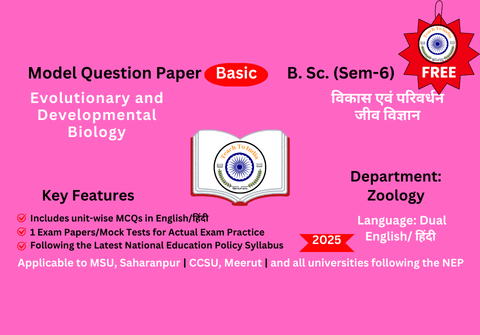
Evolutionary and Developmental Biology – विकास एवं परिवर्धन जीव विज्ञान
Key Features | मुख्य विशेषताएँ
- Bilingual Model Paper | द्विभाषी मॉडल पेपर
- Enough MCQ for Practice | अभ्यास के लिए पर्याप्त MCQ
- Exam Practice Paper with Mock Tests | मॉक टेस्ट के साथ परीक्षा अभ्यास पत्र
- Latest Syllabus as per NEP | NEP के अनुसार नवीनतम पाठ्यक्रम
- Designed by Experts | विशेषज्ञों द्वारा तैयार किया गया
The given MCQs cover only 10% of the syllabus | दिए गए बहुविकल्पीय प्रश्न केवल 10% पाठ्यक्रम को कवर करते हैं।
To cover 100% of the syllabus with summaries, upgrade to our Advanced Model Paper.| पूरा सिलेबस और सारांश कवर करने के लिए हमारा एडवांस मॉडल पेपर जॉइन करें। Join Advanced Model Paper
|
Program Class: Degree / B.Sc |
Year: Thierd |
Semester: Sixth |
||
|
Subject: ZOOLOGY |
||||
|
Course Title: Evolutionary and Developmental Biology |
||||
|
Course Learning Outcomes: On completion of this course, learners will be able to: · Understand that by biological evolution we mean that many of the organisms that inhabit the earth today are different from those that inhabited it in the past. · Understand that natural selection is one of several processes that can bring about evolution, although it can also promote stability rather than change. · Understand how the single cell formed at fertilisation forms an embryo and then a full adult organism. · Integrate genetics, molecular biology, biochemistry, cell biology, anatomy and physiology during embryonic development. · Understand a variety of interacting processes, which generate an organism’s heterogeneous shapes, size, and structural features. · Understand how a cell behaves in response to an autonomous determinant or an external signal, and the scientific reasoning exhibited in experimental life science |
||||
|
Credits: 4 |
Core Compulsory |
|||
|
Max. Marks: –25+75 |
Min. Passing Marks: 33 |
|||
|
Unit |
Topics |
|||
|
I |
Theories of Evolution · Origin of Life · Historical review of evolutionary concept: Lamarckism, Darwinism (Natural, Sexual and Artifical selection) · Modern synthetic theory of evolution · Patterns of evolution (Divergence, Convergence, Parallel, Coevolution) |
|||
|
II |
Population Genetics · Microevolution and Macroevolution: allele frequencies, genotype frequencies, Hardy- Weinberg equilibrium and conditions for its maintenance · Forces of evolution: mutation, selection, genetic drift |
|||
|
III |
Direct Evidences of Evolution · Types of fossils, Incompleteness of fossil record, Dating of fossils, Phylogeny of horse |
|||
|
IV |
Species Concept and Extinction · Biological species concept (Advantages and Limitations); Modes of speciation (Allopatric, Sympatric) · Mass extinction (Causes, Names of five major extinctions |
|||
|
V |
Gamete Fertilization and Early Development · Gametogenesis, Fertilization · Cleavage pattern · Gastrulation, fate maps · Morphogenesis |
|||
|
VI |
Developmental Genes · General concepts of organogenesis · Introduction to genetic basis of embryonic development · Developmental control genes (Homeobox genes) |
|||
|
VII |
Early Vertebrate Development · Early development of vertebrates (fish, birds & mammals) · Metamorphosis, regeneration · Environmental regulation of development |
|||
|
VIII |
Late Developmental Processes · Development of eye, kidney, limb in amphibian · Mammalian female reproductive cycles estrous cycle and menstruation · Aging: the biology of senescence |
|||
-
1
 Unit 1: MCQs - Evolutionary and Developmental Biology
 -
2
Unit 2: MCQs - Evolutionary and Developmental Biology
-
3
Unit 3: MCQs - Evolutionary and Developmental Biology
-
4
Unit 4: MCQs - Evolutionary and Developmental Biology
-
5
Unit 5: MCQs - Evolutionary and Developmental Biology
-
6
Unit 6: MCQs - Evolutionary and Developmental Biology
-
7
Unit 7: MCQs - Evolutionary and Developmental Biology
-
8
Unit 8: MCQs - Evolutionary and Developmental Biology