
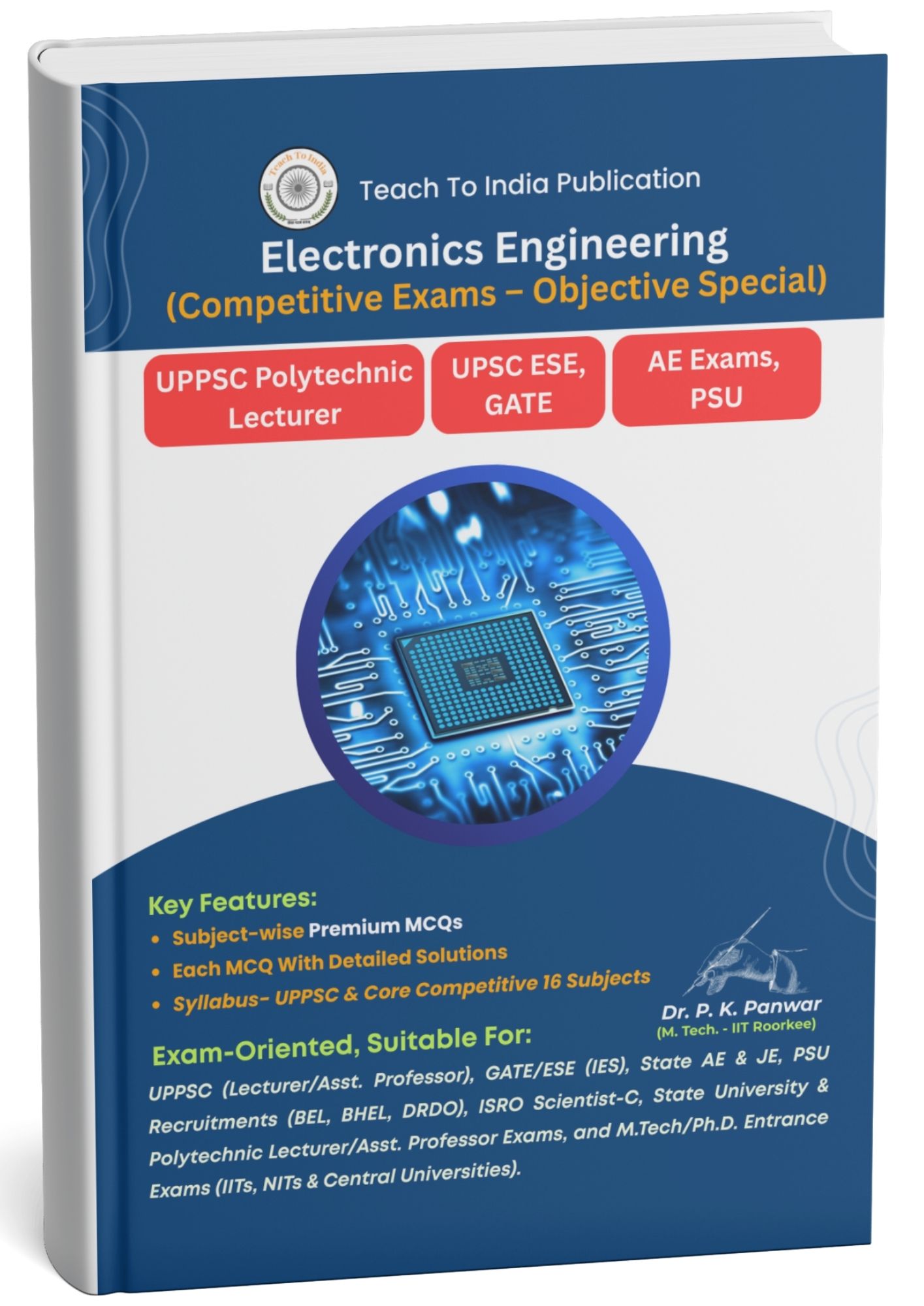

Electronics Engineering (Competitive Exams – Objective Special)
Master Electronics Engineering Concepts with Exam-Focused MCQs
Prepare with confidence for major technical and competitive examinations with Electronics Engineering (Competitive Exams – Objective Special), an English-language objective practice book designed for aspirants targeting lecturer, engineering, PSU, research, and higher-education entrance examinations.
The book is built around the core 16 competitive subjects prescribed in the UPPSC syllabus and combines subject-wise MCQs with detailed solutions. The questions are designed across Remembering, Understanding, Application, and Analysis levels to help learners strengthen conceptual clarity, develop problem-solving ability, and improve overall exam readiness.
Why This Book Stands Out
- Subject-wise Premium MCQs for systematic and focused preparation
- Detailed solutions with every MCQ for better understanding of concepts
- Questions covering Remembering, Understanding, Application, and Analysis levels
- Coverage based on the UPPSC syllabus and 16 core Electronics Engineering subjects
- Useful for both concept revision and objective-question practice
- Includes questions involving diagrams, circuit characteristics, numerical concepts, device behavior, and practical applications
- Structured in Part-1 and Part-2 for convenient subject-wise preparation
- Suitable for competitive examinations as well as higher-study entrance preparation
Comprehensive Subject Coverage
Part-1
- Electronic Devices – Semiconductor energy bands, direct and indirect band gaps, P-N junctions, Zener diodes, clippers, clampers, rectifiers, diode small-signal models, BJT, JFET and MOSFET.
- Analog Circuits – Amplifiers, biasing, frequency response, transistor models, oscillators, operational amplifiers, Schmitt triggers and active filters.
- Advanced Electronics – VLSI technology, lithography, interconnects, packaging, testing, MUX/ROM/PLA-based design, Moore and Mealy circuits, pipelining and design for testability.
- Network Theory and Basic Machines – DC and AC circuits, network theorems, mesh and nodal analysis, network graphs, RLC circuits, Laplace transforms, two-port networks, DC machines, induction machines, synchronous machines and transformers.
- Digital Electronics – Number systems, Boolean algebra, logic gates, Karnaugh maps, combinational and sequential circuits, flip-flops, counters, registers, ADCs, DACs, memories and microprocessors.
- Control Systems – Feedback, transfer functions, block diagrams, signal flow graphs, frequency response, Routh-Hurwitz criterion, root locus, Nyquist and Bode plots, stability, compensation and state-variable analysis.
- Instrumentation – Measurement principles, accuracy, precision, standards, analog and digital measurement systems, measuring instruments, errors, static and dynamic characteristics, statistical analysis and curve fitting.
- Computer Organization and Architecture – CPU, memory, I/O organization, peripheral devices, operating systems, microprocessors, microcontrollers, interrupts, DMA, interfacing and embedded systems.
Part-2
- Electromagnetics – Maxwell’s equations, vector calculus, Gauss’ and Stokes’ theorems, Poynting vector, wave propagation, transmission lines, S-parameters, Smith chart, waveguides and antennas.
- Analog Communication Systems – AM, FM, transmitters, receivers, modulation and demodulation, spectra and superheterodyne receivers.
- Digital Communication Basics – Sampling, quantization, coding, PCM, DPCM, ASK, FSK, PSK and multiple-access techniques including TDMA, FDMA and CDMA.
- Digital Signal Processing – Discrete-time signals and systems, FIR and IIR digital filters, filter design and speech, audio and radar signal-processing applications.
- Communication Networks – Networking principles, technologies, OSI model, security, packet multiplexing, scheduling, cellular networks and TCP/IP.
- Random Signals and Processes – Autocorrelation, power spectral density, white noise and filtering of random signals.
- Information Theory – Entropy, mutual information, channel capacity, Huffman coding, algebraic coding and convolutional coding.
- Microwave & Satellite Communication – LOS systems, link calculations, system design, communication satellites, satellite orbits, fibre-optic communication, optical-fibre principles, standards and system design.
Exam-Oriented Practice
The questions are designed to test more than simple factual recall. The book includes conceptual and application-oriented problems covering semiconductor behavior, diode characteristics, rectifiers, transistor operation, MOSFET/JFET concepts, amplifier analysis and other electronics fundamentals. Many questions use circuit diagrams, characteristics and numerical relationships to develop analytical thinking.
For example, the Electronic Devices section progresses from fundamental semiconductor concepts to P-N junctions, Zener regulation, clipping and clamping circuits, rectifiers, small-signal diode models, BJT, JFET and MOSFET analysis, providing focused practice for competitive examinations.
Ideal for Competitive Examination Preparation
This book is particularly useful for aspirants preparing for:
- UPPSC Lecturer / Assistant Professor
- GATE
- ESE / IES
- State AE & JE Examinations
- PSU Recruitment Examinations
- BEL, BHEL and DRDO Recruitment
- ISRO Scientist-C
- State University Lecturer / Assistant Professor Examinations
- Polytechnic Lecturer / Assistant Professor Examinations
- M.Tech Entrance Examinations
- Ph.D. Entrance Examinations
- Entrance examinations conducted by IITs, NITs and Central Universities
A Practical Companion for Electronics Engineering Aspirants
Whether you are revising core electronics concepts, practising objective questions after completing a subject, preparing for technical recruitment examinations, or strengthening your preparation for lecturer and higher-education entrance examinations, this book provides a structured collection of subject-wise Electronics Engineering MCQs with detailed solutions.
Its two-part organization makes it convenient to move systematically from Electronic Devices, Analog and Digital Electronics, Network Theory and Control Systems to Electromagnetics, Communication, DSP, Information Theory, Microwave and Satellite Communication.
Book Details
- Title: Electronics Engineering
- Subtitle: Competitive Exams – Objective Special
- Language: English
- Edition: First Edition, 2026
- Author: Dr. Parvendra Kumar
- Publisher: Teach To India Publication
- ISBN: 978-81-990811-4-7
Popular Search Terms
Electronics Engineering book, Electronics Engineering MCQ book, Electronics Engineering objective questions, Electronics Engineering competitive exam book, Electronics Engineering MCQs with solutions, Electronics Engineering practice book, UPPSC Electronics Engineering, UPPSC Lecturer Electronics Engineering, Electronics Engineering GATE preparation, GATE Electronics Engineering MCQs, ESE Electronics Engineering, IES Electronics Engineering, Electronics Engineering AE JE, PSU Electronics Engineering preparation, ISRO Scientist-C Electronics, Electronics Engineering lecturer exam book, Assistant Professor Electronics Engineering, Digital Electronics MCQ, Analog Electronics MCQ, Electronic Devices MCQ, Network Theory MCQ, Control Systems MCQ, Communication Systems MCQ, Electromagnetics MCQ, Digital Signal Processing MCQ, Information Theory MCQ, Microwave Communication MCQ.
Reviews
There are no reviews yet.